What Is an Albatross in Golf? Golf Scoring Explained

An albatross in golf is a score of three strokes under par on an individual hole. It’s also known as a double eagle, particularly in the United States.
Unlike a birdie or an eagle, an albatross is something most golfers may never experience. It describes your score on one individual hole, rather than your total score for a round. The most familiar example is completing a par 5 in just two shots.
What score is an albatross in golf?
The number of shots you need depends on the par of the hole. On a par 4, you need a hole in one; on a par 5, you need a two; and on a par 6, you need a three. An albatross is impossible on a par 3.
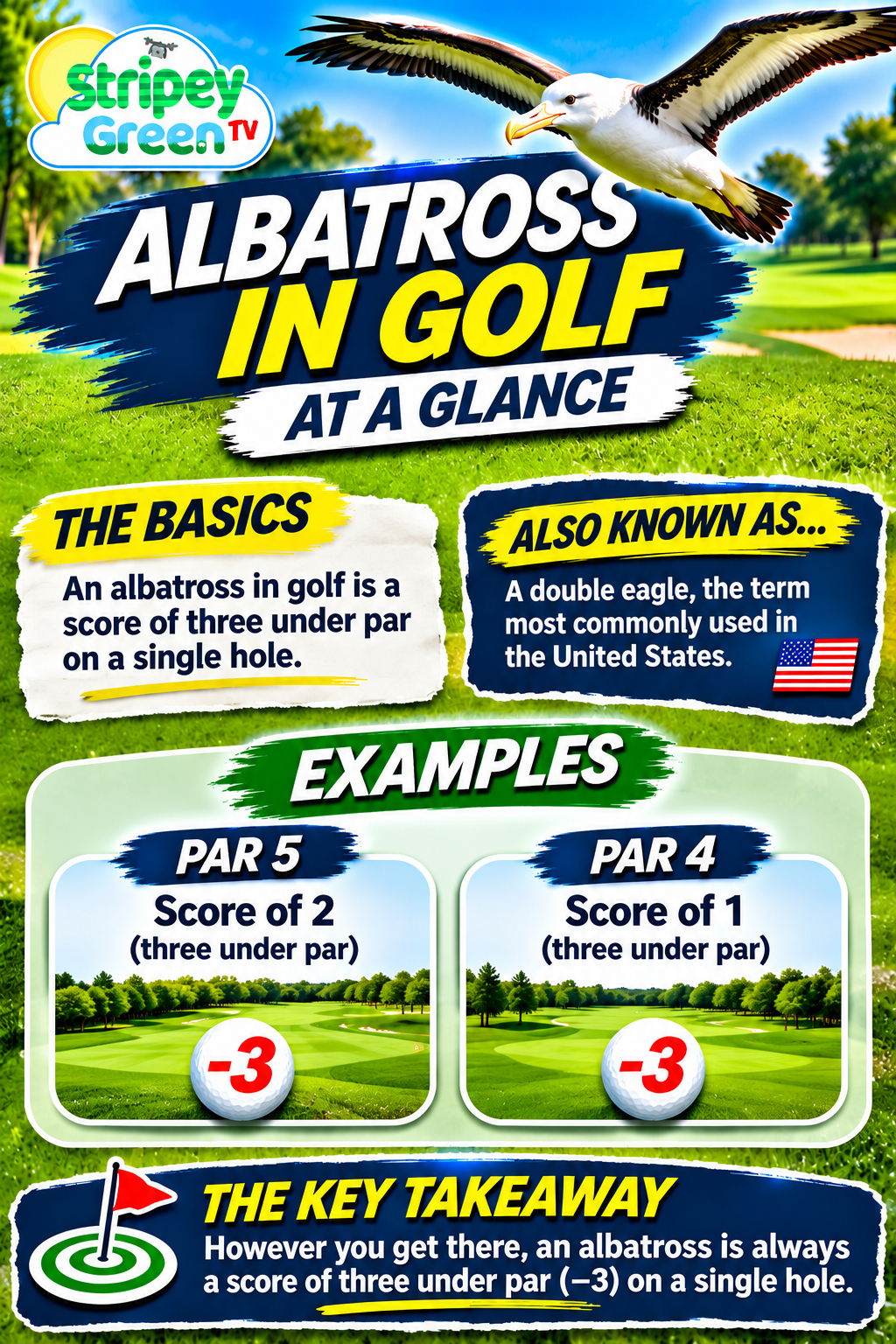
An albatross is one shot better than an eagle and two better than a birdie.
Why is an albatross also called a double eagle?
Here in the UK, albatross is the term you’ll generally hear. In the United States, golfers often call the same score a double eagle. Although the two names mean the same thing, double eagle is a slightly odd expression when you think about it. An eagle is two under par, but a double eagle is three under, not four! The albatross continues the golfing tradition of naming increasingly impressive scores after birds.
For some background on the terminology, see The Double Eagle Club’s guide to golf scoring history.
My one and only albatross at Davyhulme Golf Club
I was a member at Davyhulme Golf Club for around four years in the late nineties and early noughties, and it was there that I scored my one and only albatross.
I was playing the par 5 thirteenth off the winter tee and the ground was frozen solid. I managed to hit a massive fade over the greenkeepers’ shed and, with a little help from the frozen ground, my drive went all the way onto the winter green. I then knocked the putt in for a two!
It’s my one and only albatross, although there’s a bit of a caveat to that story. I’ve never managed one off the normal tees and onto the normal greens. I’d love to get another one in the summer, but I’m not holding my breath!
How rare is an albatross?
On a conventional par 5, an albatross normally means holing your second shot from some distance. On a par 4 you’d need a hole in one. Either is an exceptional achievement, even for a professional golfer.
An albatross is generally much rarer than a hole in one, because it usually requires holing a long approach shot rather than a tee shot on a shorter par 3. The odds vary considerably with the golfer, course and playing conditions, so a single universal figure can be misleading.
Famous albatrosses in golf
Gene Sarazen famously holed his second shot on the par 5 15th at Augusta National during the final round of the 1935 Masters. Known as the shot heard round the world, it helped him force a playoff, which he won.
Louis Oosthuizen also made Masters history in 2012 when he holed his second shot on the par 5 second hole at Augusta National. He eventually finished runner-up to Bubba Watson after a playoff.
How many Stableford points is an albatross?
A nett albatross earns five points in standard Stableford scoring. A gross albatross on a hole where you receive one stroke earns six points.
Frequently asked questions
Is an albatross better than an eagle?
Yes. An albatross is three under par, whereas an eagle is two under par.
Can you get an albatross on a par 3?
No. Even a hole in one on a par 3 is only two under par, making it an eagle.
Can a hole in one also be an albatross?
Yes. A hole in one on a par 4 is both an ace and an albatross.
What is better than an albatross?
A condor is four strokes under par on a single hole.
Is a double eagle the same as an albatross?
Yes. Both terms describe a score of three strokes under par on one hole.
Final thoughts
I’m still rather pleased with my winter albatross, even if it comes with an asterisk! Have you ever scored an albatross, and was it on a par 4 or a par 5? I’d love to hear your story in the comments.
For more scoring terms, take a look at my complete guide to golf scoring.
Bye for now!