Shot Scope LM1 vs PRGR: Which Budget Golf Launch Monitor Is Best?
DISCLOSURE: THIS POST MAY CONTAIN AFFILIATE LINKS, MEANING I GET A COMMISSION IF YOU DECIDE TO MAKE A PURCHASE THROUGH MY LINKS, AT NO COST TO YOU. PLEASE READ MY DISCLOSURE FOR MORE INFO.
If you’re looking for a portable golf launch monitor without spending hundreds or thousands of pounds, the Shot Scope LM1 and PRGR HS-130A are two interesting options. Both give you immediate feedback on speed and distance without needing a phone during practice. But which offers better value for the everyday golfer?
What particularly impresses me about the LM1 is how closely its reported performance matches the expectations set by Shot Scope. The PRGR is a capable little device, particularly for speed training, but I found that it isn’t that accurate and looking at other independent reviews, it seems that feedback suggests that its distance readings can be inconsistent. For me, the LM1 is the more compelling all-round option.
I’ve recently added the LM1 to my golf technology collection, and you can already read my Shot Scope LM1 unboxing article. I’m particularly interested in how useful it will be for regular range sessions and club gapping. For now, here is how the two devices stack up on paper and in published tests.
Shot Scope LM1 vs PRGR: specifications
| Feature | 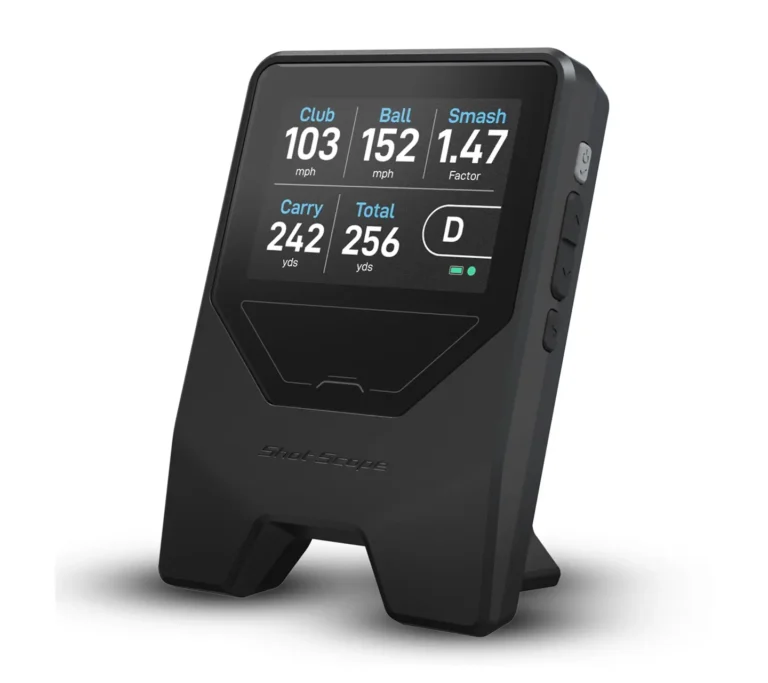 Shot Scope LM1 SGTV preferred choice | 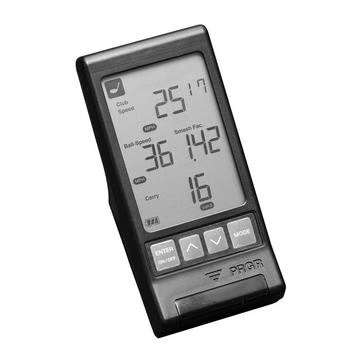 PRGR HS-130A |
|---|---|---|
| Technology | Doppler radar | Doppler radar |
| Data | Club speed, ball speed, smash factor, carry and total distance | Same five metrics |
| Display | 3.5-inch colour | Monochrome LCD |
| Power | USB rechargeable, up to 5 hours | 4 AAA batteries |
| Shot history | Bluetooth sync to free Shot Scope app | Last 500 readings on device |
| Speed training without a ball | ✓ Yes | ✓ Yes |
| Indoor and outdoor use | ✓ Yes | ✓ Yes |
| Subscription required | No | No |
| Spin or launch angle displayed | No | No |
Sources: LM1 specifications and the PRGR HS-130A manual.
Which launch monitor is more accurate?
The independent results for the LM1 are encouraging, particularly for well-struck irons. Golf Insider’s nine-shot comparison against a Foresight GC Hawk found all six wedge and seven-iron carry readings within two yards of its reference device. However, one poorly struck driver shot was overestimated by 24 yards. That is an important reminder that a budget monitor cannot fully describe every type of ball flight.
MyGolfSpy’s initial LM1 testing favoured its accuracy over the PRGR, but its broader 2026 buyers’ guide found the LM1 less dependable with longer clubs than shorter irons. Golfmagic also reported useful distance readings alongside some notable club speed discrepancies.
The PRGR has its own strengths. PGA coach Ross Eves reported good speed readings against premium devices, while noting that estimated distances can be misleading on poor strikes. Neither device should be treated as a replacement for a full fitting launch monitor which can cost £2k-£20k.
On balance, having tried them both, I much prefer the LM1. I bought the PRGR long before the LM1 was released. At the time it was a groundbreaking device for the price, but the LM1 has changed things. When I bought it, the PRGR was the only device I could find under £500 that could measure swing speed without a ball. Fast forward to the LM1 and you’re getting all this and much more. The PRGR is useful, but can be inconsistent, while I think the LM1 has been particularly impressive. It’s important to note that this is informal feedback rather than a controlled accuracy test.
Display, setup and app connectivity
The LM1’s colour screen and automatic session syncing are the biggest reasons I prefer it. If you already use Shot Scope products, keeping practice data within the same ecosystem is appealing. The PRGR takes a simpler approach: switch it on, select your club and practice. It stores up to 500 measurements, but the HS-130A does not automatically sync those readings to an app.
Indoor practice and swing speed training
Both can be used for net practice and speed training without hitting a ball. Neither displays spin, launch angle or shot direction, so a calculated carry distance cannot tell you whether your ball would have finished in the middle of the fairway. For speed work, use consistent positioning and compare trends rather than assuming every reading is exact.
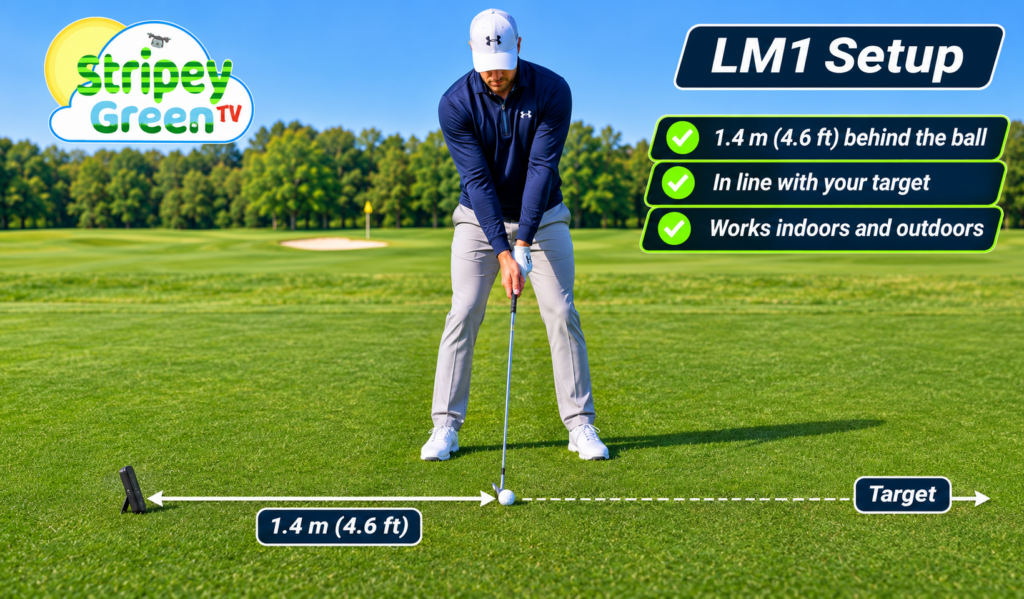
LM1 speed training setup: For swing speed training without a ball, position the LM1 2.1 metres (approximately 7 feet) behind your normal ball position, rather than the 1.4 metres used for hitting golf balls.
For speed training, the ability to measure a swing without a ball is a major selling point. You can use either monitor with a speed stick, establish a baseline and track your progress over time. See my guides to the best golf swing speed training tools, how to measure swing speed and my SuperSpeed review.
How does the LM1 compare with the Garmin Approach R10?
I also own a Garmin Approach R10, a considerably more expensive launch monitor. The appeal of the LM1 is that it covers many of the basic speed and distance measurements I want from a practice session at a much lower price. The R10 offers additional ball-flight metrics and simulator functionality, so the two are not direct equivalents. I have yet to establish how closely my own LM1 readings match my R10 in a controlled comparison…but I’ll be testing that soon!
More useful data, without a subscription
Both budget devices report the same five headline measurements. The LM1’s advantage is how it presents and retains the data, with its colour display and app-based session history. Neither requires an ongoing subscription for its core features. That is a significant benefit compared with other launch monitors costing under £2,000, where optional or required software subscriptions can add substantially to the total cost of ownership.
UK price and value for money
The LM1 has a UK recommended retail price of £199.99. A 15% discount from that price would bring it to £169.99 (assuming the STRIPEYGREEN code applies). The PRGR is also frequently discounted: Clubhouse Golf has advertised it at £179. Prices and availability can change, so check at checkout rather than relying on these examples.
For the latest LM1 offer, visit my Shot Scope LM1 discount coupon and use code STRIPEYGREEN where eligible. You can also find other offers in the Shot Scope discount hub.
SGTV verdict: which should you buy?
In my opinion I would lean heavily towards the LM1. For golfers who want a modern display, rechargeable battery and an easy way to keep track of practice sessions it’s a no-brainer! The PRGR remains an attractive alternative for anyone who values pocket-sized simplicity, replaceable batteries and standalone speed feedback. If you need detailed ball flight analysis or simulator play, neither is the right purchase.
I’ll be adding further testing results and comparisons with my Garmin Approach R10 as I spend more time practising with the LM1.
Bye for now!

Frequently asked questions
Do either require a subscription? No, the basic functions of both devices work without a subscription.
Can they measure swing speed without a golf ball? Yes, both support practice swings for speed training.
Can they measure spin rate? Neither provides a spin rate reading to the golfer.
Which is better for tracking practice over time? The LM1 has the advantage of automatic app syncing, whereas the PRGR HS-130A stores measurements locally.